Showing posts with label Region--Central. Show all posts

Thursday, May 28, 2020

Unemployment Insurance Claims Data Shed Light on the Local Economic Impacts of the COVID-19 Pandemic in Central Utah


By Lecia Parks Langston, Senior Economist


“You have power over your mind — not outside events. Realize this, and you will find strength.” Marcus Aurelius

In the wake of the COVID-19 pandemic, businesses lost revenues and workers lost jobs. But because of the time it takes to collect and collate data, economists have been left without much information to quantify the economic impacts at the local level.

But there is one ray of data illumination. Claims for unemployment benefits are promptly available and provide information about a large cross section of the economy. This post will outline what light unemployment claims data sheds on the state of central Utah’s economy.

While not all workers are protected by unemployment insurance laws, roughly 95% of jobs are covered. This makes claims data an exceptional source of information about the economy. Not included under unemployment insurance laws are most self-employed workers, about half of agricultural employment, unpaid family workers, railroad personnel (covered separately) and many nonprofit organizations (such as churches). Also, some out-of-work employees may not have worked a sufficient work history to qualify for unemployment insurance benefits, but may file anyway. Fortunately, in this time of economic distress, the social safety nets of the unemployment insurance program, special national COVID-19 funding and social programs are working together to keep workers’ income and well-being stable.

Unemployment claimants and the unemployed; they aren’t the same


Also, keep in mind that, in addition to individuals drawing unemployment benefits, the unemployment rate includes those entering and re-entering the workforce and noncovered groups without current employment. This means the number of “unemployed” will be greater than the number of claimants. In “normal” times, only about 40% of the “unemployed” are claiming benefits. The generally reported unemployment rate also has a work-search requirement. If you haven’t made any minimal attempts to find work, you aren’t counted as “unemployed.”

Watch this Space


While this analysis won’t be updated regularly, new data will be added to the data visualization on a weekly basis allowing readers to check back for the latest information.

An Unprecedented Event


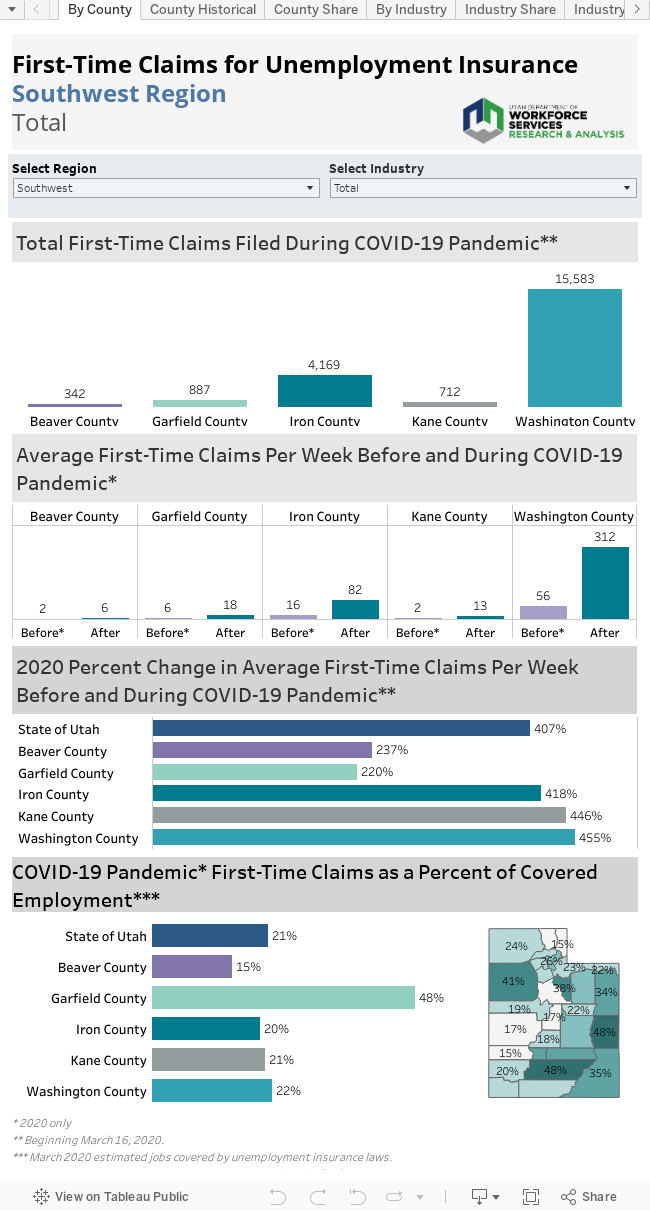
Not surprisingly, first-time claims for unemployment benefits soared in Utah and across the nation as the pandemic swept across the country. This increase is unprecedented since the creation of unemployment insurance coverage during the Great Depression. Week 12 (beginning March 16) marks the start of this unparalleled surge in claims. On a positive note, while new claims for unemployment benefits have skyrocketed in Utah, the state currently shows one of the lowest claims rates in the nation.

For most central Utah counties, initial claims peaked in the third week of the pandemic and have since tapered downward. Sevier County proved the lone exception peaking in the second week. Since mid-March, more than 1,383 new claims were filed in the region. In all of 2019, only 1,270 initial claims were filed. By week 19, claims measured considerably lower but continued to run substantially greater than in previous years, basically on par with the Great Recession.

Here’s another example of the tremendous flood of new claims. Prior to the COVID-19 pandemic, counties in central Utah averaged a total of 50 first-time claims per week. This time period in early 2020 included seasonally high-claims weeks in January. In the weeks following, an average of 173 claims were filed each week for an increase of 604%.

However, despite this historic increase in initial claims, most of central Utah fared much better than other regions in the state and nation. Even though Utah had the third lowest claims rate in the nation, its new claims increased 1,378% during the pandemic. Statewide, claims filed during the pandemic measured 10% of employment covered by unemployment insurance laws compared to only 6% in central Utah.

Who took the hardest hit?


Counties with a high-dependence on tourism felt the greatest economic and employment shocks in the slowdown. In central Utah, only Wayne County maintains a significant share of employment in tourism-related industries. It was also the hardest hit by the COVID-19 pandemic. In Wayne County, roughly 11% of individuals covered by unemployment insurance have filed a claim. Moreover, many seasonal Wayne County workers were already drawing unemployment benefits before the pandemic began. In contrast, in Millard County only 4% of covered workers filed a claim in the weeks following the start of the pandemic. Sanpete (5%) and Sevier (6%) counties also displayed relatively low rates. While Piute County’s figure measured somewhat higher at 10%, many of these claims reflect persons employed outside the county rather than within it.

Tourism and COVID-19


Especially in the early stages of the pandemic, this is a story of tourism-dependent industries. Almost 22% of post-COVID-19 initial claims filed in central Utah represented workers previously employed in accommodations and food services. In addition, the true effect of the pandemic on this industry is masked by a large number of claims classified as industry “unknown” in the early days of the claims flood. Undoubtedly, many of these claims would rightfully be classified in accommodations/food services if the appropriate information were available.

Other high-claims industries included healthcare/social assistance (reflecting the cessation of elective procedures and visits) and retail trade. Many of these high-claims industries reflect their high share of total employment in general. In addition, they often serve the public face to face or have encountered damage due to the decline in demand for travel constraints.

The High and the Low


Because of its job-to-job nature, the construction industry typically accounts for 30-50% of first-time claims in the region. However, although construction’s new claims have also increased, they have increased at a much slower-than-average rate. After the COVID-19 pandemic hit, construction contributed only about 4% of first-time claims. Ease of social-distancing and good weather have helped construction maintain its employment levels. New claims measured just 3% of covered construction employment.

Only a portion of agricultural employment is covered by unemployment insurance laws. However, as companies work to keep America fed, agribusiness in the region laid off few employees. Only 2% of central Utah’s covered agricultural workers have filed a claim during the COVID-19 pandemic.

Public administration, utilities, mining and educational services (including public and higher education), have also managed to keep a higher percentage of their workforces employed.

County by County


Millard County


  • Along with Beaver County, Millard County showed the lowest COVID-19-related claims rate in the state (4%).
  • Millard County has relatively high concentrations of employment in industries (such as covered agriculture and utilities) least affected by the pandemic.

  • Prior to the COVID-19 pandemic, Millard County averaged three unemployment claims per week compared to 26 new claims afterward, an increase of 758%.
  • Unlike most areas where accommodations/food services generated the largest number of claims, in Millard County, healthcare/social assistance topped the industry ranking followed by retail trade.
  • Construction, healthcare/social assistance and accommodations/food services showed roughly equal claims as a percentage of covered employment.
  • Millard County accounted for 12% of the Central Utah Region’s new claims prior to the pandemic, and 15% of claims during the pandemic.

Piute County


  • Less-populated Piute County maintains little employment covered under Utah’s unemployment insurance laws. In addition, a notable share of residents are employed in other counties which muddies some analysis.

  • Prior to the COVID-19 pandemic, Piute County averaged one new claim per week, compared to an average of four claims per week during the pandemic. This change represents an increase of 610%.
  • Roughly 45% of claims were filed from workers furloughed from the accommodations/food service industry. A large share of claims from the “unknown” industry category most likely originated from this industry as well.
  • Other industries contributed few new claims.
  • Piute County accounted for the same percentage (2%) of the region’s claims before and during the pandemic.

Sanpete County


  • After spiking in the early weeks of the slowdown, Sanpete County’s claims are now running roughly equivalent to the numbers experienced in the previous recession. In most Utah counties, first-time claims continue to flow in at a much higher level.
  • In the weeks before the COVID-19 pandemic, Sanpete County averaged eight initial claims per week. After the pandemic hit, claimants filed an average of 58 claims per week, marking an increase of 588%.
  • In Sanpete County, first-time claims during the pandemic period measured 5% of covered employment. That places Sanpete County near the bottom of a county-by-county ranking.
  • Unusually, healthcare/social assistance showed the highest number of new claims followed by the “usual suspect” — accommodations/food services — in the second spot.
  • Sanpete County showed a notably high share of claims emanating from an unspecified industry.
  • The relatively high percentage of mining claims compared to industry employment in Sanpete County likely reflects individuals working in other counties.

Sevier County


  • Sevier County generated the highest number of claims in the region during the pandemic.
  • Prior to the COVID-19 pandemic, Sevier County averaged 10 first-time claims per week compared with 58 claims during the pandemic. This increase of 627% ranked as the largest in the region, but far below the statewide average of 1,378%.
  • Accommodations/food services, healthcare/social assistance and retail trade originated the highest number of initial claims after the pandemic hit.
  • More than one-fourth of Sevier County’s COVID-19 initial claims were initiated in the accommodations/food services industry.
  • Sevier County’s regional share of new claims held relatively steady before and during the pandemic.

Wayne County


  • Of the five counties located in central Utah, Wayne County maintains the heaviest dependency on tourism-related employment. It also shows the highest first-time claims to covered employment ratio in the area.
  • Before the COVID-19 pandemic, an average of three initial claims were being filed in Wayne County compared to an average of 14 claims in the following weeks. The pre-to-post-COVID-19 increase registered 410%, the lowest in the region. Many seasonal workers were already drawing unemployment insurance benefits.
  • Initial claims for unemployment benefits filed during the pandemic as a percent of covered employment measured 11%, near the middle of a ranking of all Utah counties.
  • Here too, accommodations/food services was the source of the largest number of new claims, trailed far behind by retail trade.
  • More than half of all new claims during the pandemic time period originated from accommodations and food services. Roughly 20% of workers in this industry filed a new claim for unemployment after the start of the COVID-19 pandemic. Many seasonal workers were already receiving benefits.

Tuesday, April 7, 2020

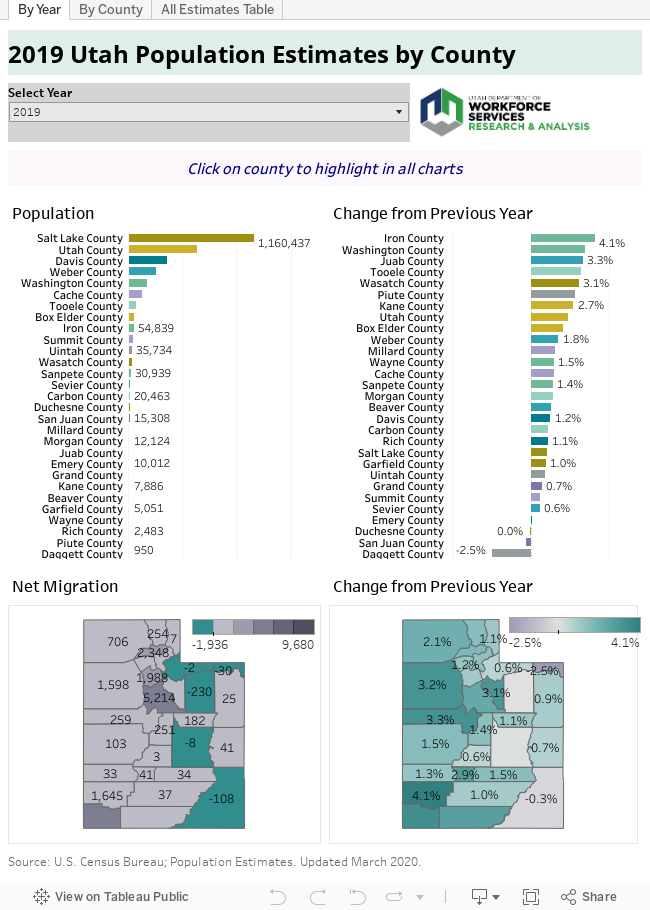
The U.S. Census Bureau Releases County Population Estimates for 2019

Next year, actual counts from the decennial census will be available

By Lecia Parks Langston, Senior Economist
“Any time you have population growth, there are business opportunities.” Roland Dorson
 
Hopefully, all Utahns are taking a break from COVID-19 concerns to respond (by phone, online or by mail) to their 2020 Census questionnaires (https://2020census.gov/). Since the Census results help determine how billions of dollars in federal funding are spent, accurate counts are important in order for Utah’s communities to get their “fair share.”
 
Because the actual counts are not yet available, the U.S. Census Bureau has just released the last set of population estimates for the decade. What do they show?


  • Iron County took the lead in population growth rates for 2019 — up by 4.1%. Following close behind was its neighbor, Washington County, with a growth rate of 3.5%.
  • Other fast-growing areas included counties at the edge of urban spread, such as Juab, Tooele and Wasatch.
  • Although Piute County saw an increase of only about 30 individuals, its small base population also resulted in a strong percentage increase (2.9%).
  • Utah County showed the highest percentage increase (2.4%) of the big-four Wasatch Front counties.
  • Estimates for both San Juan and Daggett counties suggested a decline in population, while Duchesne County’s population appeared to hold steady.
  • Utah County experienced the largest numeric gain in population — nearly 15,000 residents, followed by Salt Lake County (up about 12,000) and Washington County (up nearly 6,000).
  • Utah and Washington counties finished neck-and-neck in the race for net in-migration. Utah County’s net in-migration measured 5,200 compared to 5,100 for Washington County.
  • Several counties displayed net out-migration. Most notable on the list were Duchesne and San Juan counties. Daggett, Emery and Summit counties showed lesser out-migration estimates.
  • For its size, Utah County shows a relatively high number of births and a low number of deaths, placing its natural increase not far behind population-dense Salt Lake County.
  • Although Washington and Cache counties showed roughly equivalent numbers of births, deaths in Washington County measured much higher.
  • In 2019, Emery County experienced its first (albeit small) population growth in more than a decade.
  • Morgan County’s 2019 growth rate slipped below the state average for the first time this decade.
  • Wayne County saw its best population growth (1.5%) of the past 10 years in 2019.
  • Between 2010 and 2019, Wasatch County was the third fastest growing county in the nation. Washington County (St George, UT MSA) was the fifth fastest growing metropolitan area in the United States between 2010 and 2019. Its relatively small size contributes mathematically to a high growth rate. The Provo-Orem, UT MSA ranked ninth.
These aren’t the only estimates in town. The Kem C. Gardner Policy Institute at the University of Utah has assembled the Utah Population Committee (UPC) to reinstitute the population-estimates work previously conducted by the Utah Population Estimates Committee (UPEC). These estimates can be found here.
U.S. Census Bureau estimates use the same methodology in producing population figures for every county in the nation. Therefore, for nationwide comparisons, U.S. Census Bureau estimates may have the advantage. On the other hand, UPC population estimates have the benefit of local-analyst expertise and additional data sources.

Monday, December 23, 2019

Pitman Farms rejects workers demand for higher wages

Scores of American Samoan migrant workers who originally came to the mainland for job opportunities at the Pitman Farms turkey processing plant went on a labor strike. The workers-on-strike, which numbered nearly 50 during the demonstration, submitted a petition with written signatures, which entailed the reasons for their strike and what changes they wanted from Pitman Family Farms in order to go back to work.


The workers specified the wage increase they wanted: A boost from $10.50 to $15 per hour. Lynne Roux, HR Manager for Pitman Farms’ Moroni operation, was on hand during the strike trying to convince the workers to return to their stations. “This is not the way to do it,” Roux told the Messenger. “We do not take lightly to strikes. We are happy to have a one on one conversation with each of them about their grievances, but if they’re not willing to come back to work today, we will take it as a voluntary resignation.” Sanpete Messenger

Fillmore plans new city park

The city over many years has built up a reserve of about $13.5 million in unrestricted cash— money that can legally be used for discretionary spending—in its electric, sewer and water enterprise funds. Council members said the city has saved so much money that now is a good time to give it back to citizens in the form of a project that would benefit the community — a city park.


The new park would be built on city land near the current baseball field. It would feature two pavilions, a new sand volleyball court, pickle ball courts, a splash pad, bathroom facilities, a playground and parking for a bit more than 50 vehicles.


The added expense to the city for upkeep on the new park would most likely be covered by the $50,000 in new annual revenues generated by the city’s RAP tax, approved by voters in the city’s most recent municipal election.


After hearing multiple public comments, the city council eventually voted unanimously to move the $1 million for the park project from the electric enterprise fund into the city’s capital projects fund. Millard County Chronicle Progress

Sanpete County Water projects funded

Two small towns have started construction on big culinary water projects. Both Sterling and Mayfield are redeveloping their culinary springs with funding from Emergency Community Water Assistance Grants (ECWAG).


Sterling is redeveloping two springs, replacing a pipeline between the springs and burying a pipe that carries water from both springs to the town water tank. The total project cost is $900,000. ECWAG is covering $828,000. The town got a Community Development Block Grant for $42,000 and put up $30,000 of its own money.


Mayfield is working on five springs, two near the mouth of 12-Mile Canyon, two about a mile up the canyon and one in a side canyon called South Hollow. The total projected cost of the Mayfield work is $720,000. The town got a planning grant for $13,500 from the Utah Division of Drinking Water and $700,000 from ECWAG. The town itself is covering the rest. Sanpete Messenger

Millard County Commissioners reject zone change

Millard County commissioners voted unanimously to reject an application for a zoning change on 2,000 acres of land nine miles outside Hinckley, effectively killing a local businessman’s plan to build an industrial hog operation on the site. Steele Weston, owner of Pumbaa Farms, was the applicant. His plan, debated numerous times in public, sought to house up to 30,000 hogs in seven barns as part of a large-scale farrowing operation. Millard County Chronicle Progress

Delta council OKs sewer contract

Delta City Council members approved a $145,000 contract last Wednesday for work on the city’s aging sewer system. Val Kotter & Sons, a Brigham City company was awarded the project. The sewer project is the first step in repairing the city’s sewer system. A master sewer plan created by Sunrise and submitted to the city in April estimated the city could spend as much as $19 million to overhaul the entire system. Millard County Chronicle Progress

Delta City airport construction nears finish

Construction to repave the runway, build more accessible ground approaches to the strip of asphalt as well as install new lighting and new stripes should be completed in December. The city received a $4.16 million grant from the Federal Aviation Administration this past summer to make the improvements. Geneva Rock is the main contractor on the project. Millard County Chronicle Progress

Sevier Playa potash project gets planning nod

County planning commissioners approved a conditional use permit for the Crystal Peak Minerals Sevier Playa potash mining project last week. Construction on the project is expected to begin sometime next year. Operations are expected to commence three to four years after construction starts, commissioners were told. Potash, or potassium sulfate, is a mineral deposit used in premium fertilizer. The Sevier Playa project is expected to mine the mineral for the next 35 years. Millard County Chronicle Progress

Millard County Planning Commission OKs zone change for hog production facility

The developer behind a proposed industrial-strength hog production facility successfully navigated his first hurdle despite a considerable show of public consternation. The Millard County Planning Commission voted 3-2 to advance a zoning change to county commissioners that could pave the way for the development of a concentrated confined animal feeding operation involving some 30,000 head of hogs on a patch of desert a little less than 10 miles west of Hinckley. Millard County Chronicle Progress

Monday, October 14, 2019

Fish Lake improvements progressing

More than $3 million worth of upgrades are under construction in the Fish Lake Basin. Improvements include upgrades to the parking areas at the Fish Lake Lodge and Lakeside marinas, as well as upgrades to the marinas as well as one at Bowery Haven. A fishing pier at Bowery is also in the plans. However, the pier and expansion of the marinas are pending final permitting from the U.S. Corps of Engineers.


In the meantime, parking areas have been expanded and improved. Another project is a boardwalk at Twin Creeks. A spawning ground for Kokanee Salmon, Twin Creeks has become a popular destination for people in the fall, hoping to view the fish as they swim upstream. Future projects for the basin include upgrades to roads in the area. Richfield Reaper

Ephraim issues permit for condos at old Travel Inn site

The Ephraim city council approved a conditional use permit for a new condominium project on the site of the Travel Inn. The condos will have 39 units: 30 with two bedrooms and nine with three bedrooms. There will be 96 parking spaces total, with 43 covered. The units will be constructed with vinyl siding for “a good look and low maintenance.” Sanpete Messenger

Bridge Replacement north of Austin

Traffic north of Austin on Utah State Route 118 is limited to one lane as crews are working to replace a bridge. The new bridge will be a single span using a pre-stressed concrete slab 63-feet long by 44-feet wide. In the early phases of the project the contractor — W.W. Clyde — relocated water lines and built a bypass road at the bridge where SR 118 crosses over the Sevier River. This is so traffic can still travel through the area as the bridge is torn down and replaced. The project is approximately a $3 million investment in the road’s infrastructure. Richfield Reaper

Construction begins on Salina pool

The Salina City pool repair project has begun and includes the demolition of the interior walls, plumbing, electrical and a remodel of the interior components, as well as a 10-foot addition to the pool with upgrades to mechanical components of the pool system, which includes filtration, pumping and chlorination systems. It also includes expanding the pool deck area, relining the pool and upgrading the exterior lighting system.


Funding for the project has been procured by personal and business donations, various fundraising efforts and events organized by the Salina City Swimming Pool Fundraising committee, as well as a 20-year loan of $1 million at 1 percent interest from the Utah Permanent Community Impact Fund Board. Richfield Reaper

Wales will receive $602K grant to improve culinary water system

The town of Wales was notified will receive a $602,500 Emergency Community Water Assistance Grant (ECWAG) through the USDA Rural Development program to improve its culinary water system. Funds will be used to drill a replacement well because the existing well pulls in silt during peak use in summer. The work will also include development of additional springs near the existing lime kiln springs in Wales Canyon. The well and springs currently provide culinary water for the community of Wales for both indoor and outdoor uses. Sanpete Messenger

Richfield City embarks on a $4 million roads project

Crews began work on a roads project in Richfield City that will refurbish and repair the majority of the streets on the east side of town. The project also includes repairs on the west side of town. Much of the project will focus on a microseal process, Creamer said. Instead of the traditional chip seal, where a layer of oil is put down and then covered with gravel, the microseal incorporates the oil with the gravel.


The city is also improving Flying J Drive on the north side of town as part of the project. Several intersections are also due to be reconstructed as part of the project including two along 800 South at Cove View Road and 300 West and another at 600 North and Upland Drive. Richfield Reaper

Maverick coming to Gunnison

A new Maverik store will open at Main and Center Streets in Gunnison in about four months. Demolition of a couple of dilapidated buildings on the northwest corner of the intersection was completed Monday to make way for the new store.


The store will be 1,319 square feet and will have eight pumps for cars and six pumps for trucks. It will have indoor and outdoor eating areas. The general contractor is Stout Building Contractors of Bountiful. Sanpete Messenger

Thursday, July 18, 2019

Embattled company to close a second Utah treatment center for troubled teens

A company that runs treatment centers for troubled teens is closing a second Utah facility following intense scrutiny into the staff’s treatment of young people.


Sequel Youth and Family Services will shutter Mount Pleasant Academy within the next month. The decision comes just days after the company announced it will close Red Rock Canyon School, a St. George treatment center that has come under fire following a riot and recent revelations about the number of staffers accused of assaulting students.


Sequel said that its decision to close Mount Pleasant Academy is not connected to Red Rock or staffing issues, and instead was based on low enrollment. Mount Pleasant Academy is advertised as a 16-bed residential treatment center for teen boys who are struggling with sexual issues. Salt Lake Tribune

A new cash crop – Industrial hemp farm starting first season near Monroe

For several weeks, lines of white plastic on approximately 120 acres near the outskirts of Monroe have fueled rumors. The industrial hemp farm is the result of a number of factors coming together, perhaps the most significant of which is the passage of the 2018 federal farm bill that made farming hemp legal on the Federal level. From there, the operation had to obtain licenses and permits to farm industrial hemp.


One important distinction needs to be made when it comes to hemp — it’s not the same as marijuana used to get high. The farm has to maintain a THC [tetrahydrocannabinol] level of under 0.3 percent. At that level, it would be impossible to feel the psychoactive effects associated with recreational use of marijuana. The goal behind the operation near Monroe is not only to harvest CBD oil, but also to provide quality control in doing so. Richfield Reaper

Latest addition to evolving energy hub announced

Millard County could soon be home to the world’s largest renewable energy storage operation, Gov. Gary Herbert announced during his annual Energy Summit in Salt Lake City.


The project is a partnership between Mitsubishi Hitachi Power Systems (MHPS), makers of turbines powered by hydrogen and natural gas, and Magnum Development, which is developing a number of fuel storage and delivery ventures near the Intermountain Power Project (IPP).


This new initiative, dubbed the Advanced Clean Energy Storage (ACES) project, aims to eventually generate up to 1,000 megawatts of 100 percent clean energy— enough electricity to power 150,000 homes for an entire year—on demand utilizing Magnum’s unique underground salt domes to store air under high pressure. Air heats to a high temperature under high pressure or can be heated to power turbines, according to the Energy Storage Association, thus generating zero-carbon electricity during peak demand times, when other renewable sources, such as wind and solar alone, may be unable to meet the needs of power-hungry communities across the West.


The ACES project follows local permitting approval a few weeks ago of the TransWest Express high-voltage power line project, a massive 730-mile power transmission initiative that aims to connect 3,000 megawatts of renewable energy in Wyoming with customers across the western region. A converter station is planned for Millard County as well as 93 miles of line within the county’s borders.


Premium Energy Holdings, a California venture, also filed a preliminary application for a permit from the Federal Energy Regulatory Commission on May 9 to build a closed-loop, 2,000 megawatt hydro electric power project utilizing Delta’s DMAD Reservoir and a proposed new reservoir in the mountains surrounding Oak City.


The culmination of all these projects would result in Millard County becoming a hub of renewable power generation and transmission initiatives serving the entire western electric grid. Millard County Chronicle Progress