A new Maverik store will open at Main and Center Streets in Gunnison in about four months. Demolition of a couple of dilapidated buildings on the northwest corner of the intersection was completed Monday to make way for the new store.
The store will be 1,319 square feet and will have eight pumps for cars and six pumps for trucks. It will have indoor and outdoor eating areas. The general contractor is Stout Building Contractors of Bountiful. Sanpete Messenger
Showing posts with label New Jobs. Show all posts
Showing posts with label New Jobs. Show all posts
Monday, October 14, 2019
Thursday, July 18, 2019
Organic beef harvesting facility looks good to commissioners
The Sanpete County Commission greeted the news of a potential new cattle “harvesting” facility with enthusiasm and hoped the facility will open soon. A representative of American Beef, L.L.C., spoke to the commission about the potential impact opening a beef rendering plant in an abandoned dairy farm would have on the roads adjacent to the plant.
The new plant would aim to take advantage of new markets for “organic and all-natural grass-fed beef” by taking local cattle, raised on grass and without chemical fertilizers, and processing it in an environmentally sensitive manner. It would employ 80 employees, each of whom would be paid at least $15 an hour. The company plans to start installing the plant as soon as August 15, after the county planning commission approves their plans. Sanpete Messenger
The new plant would aim to take advantage of new markets for “organic and all-natural grass-fed beef” by taking local cattle, raised on grass and without chemical fertilizers, and processing it in an environmentally sensitive manner. It would employ 80 employees, each of whom would be paid at least $15 an hour. The company plans to start installing the plant as soon as August 15, after the county planning commission approves their plans. Sanpete Messenger


Monday, May 21, 2018
Ephraim ServerPlus looking for employees
ServerPlus, a customer service and tech support company that caters to internet service providers and other tech clients, opened a call center in downtown Ephraim in November and is currently hiring. The call center is different than some others in the area, because people call in looking for help from the ServerPlus broadband support technicians, as opposed to making outbound calls. Sanpete Messenger
Tuesday, June 27, 2017
Utah Heritage Credit Union to get new building in Ephraim
Utah Heritage Credit Union has started on a project that will culminate in a new building on Main Street in Ephraim. The general contractor is Landmark Construction of Logan, but Todd Alder of Ephraim, owner of Todd Alder Construction, will be the construction superintendent, and most of the subcontractors will be from Sanpete County. The new building will have 3,840 square feet on the ground level, with 2,990 square feet in the basement. The basement won’t be occupied at first but will be available for expansion. Sanpete Messenger
Tuesday, April 4, 2017
ACT Aerospace expansion could bring 100 manufacturing jobs to Sanpete County
The owners of ACT Aerospace have made a proposal to the Gunnison City Council to buy 19 acres of city-owned property for a new production facility, which they said would create 100 jobs. The council voted unanimously to move forward with negotiating details of the land sale.
ACT has a potential partner company which has been contracting with aerospace parts producers overseas and wants to bring some of the contracts back to the United States. ACT currently manufactures parts for Bell Helicopter and Honda Aircraft. The expansion would enable the company to do the same kind of work on a larger scale. Sanpete Messenger
ACT has a potential partner company which has been contracting with aerospace parts producers overseas and wants to bring some of the contracts back to the United States. ACT currently manufactures parts for Bell Helicopter and Honda Aircraft. The expansion would enable the company to do the same kind of work on a larger scale. Sanpete Messenger
Tuesday, October 18, 2016
Wayne County Economic Update
As is often the case for less-populated counties, what goes up rapidly can just as rapidly come down. Wayne County’s skyrocketing nonfarm job growth rate (16 percent in January) has evaporated in just six months. Whether the county can revive its employment expansion before year end is yet to be seen. Despite a tumbling job growth rate, joblessness has returned to its recent slowly declining ways. Although the unemployment rate remains high, first-time claims activity remains low. Wayne County’s mixed bag of indicators is rounded out by strong performance in both construction-permitting and sales.

- In total, between the second quarters of 2015 and 2016, Wayne County’s nonfarm jobs increased by almost 5 percent.
- Unfortunately, by quarter-end, the county was experiencing slight year-over employment contraction.
- On an industry level, retail trade’s job gains were canceled out by leisure/hospitality services’ job losses.
- Other industries showed minor changes in employment totals.
- After a brief lull, Wayne County's jobless rate continued on its slow three-year decline and is down nearly a full percentage point from last year.
- The county’s August 2016 unemployment rate of 7.9 percent reflects a seasonal, tourism-driven economy.
- First-time claims for unemployment insurance are currently following a seasonal pattern suggesting that no unusual layoff activity has occurred so far in 2016.
- The leisure/hospitality services industry has generated the lion’s share of new claims so far this year.
- The county’s average monthly nonfarm wage took a breather from its recent expansion.
- Between the second quarters of 2015 and 2016, the average wage was virtually unchanged.
- Wayne County’s notable increase in permitted construction values is being driven by several nonresidential projects.
- New home building is down slightly from last year.
- Gross taxable sales were up almost 5 percent when the second quarters of 2015 and 2016 are compared marking four straight quarters of sales gains.
- Retail trade and accommodations accounted for much of the second quarter improvement.
Sevier County Economic Update
Sevier County has backed off from the healthy job growth it experienced in2015. Nonfarm job totals seem to be treading water with only marginal improvement. Although some industries have made employment strides, others have shed jobs. Slower job growth coordinates with an uptick in unemployment during spring and early summer (which has since abated). First-time claims for unemployment insurance currently show no sign of unusual economic distress. On the other hand, a dip in gross taxable sales combines with slower job growth to suggest the economy could use some revitalization.
- After a brief dip into negative territory in May, Sevier County’s June 2016 nonfarm jobs total edged up by a little more than 1 percent (up about 110 jobs).
- Healthcare/social services made the largest employment contributions with help from mining, construction and the public sector.
- However, trade, information, leisure/hospitality services and other services all took notable job hits.
- After a brief uptick between March and June, Sevier County's unemployment rate has slipped back down to more normal levels.
- Joblessness measured 4.3 percent in August 2016, slightly higher than the statewide average, but below the national rate.
- In the first ten months of 2016, first-time claims for unemployment insurance followed a traditional seasonal pattern with no signs of unusual stress.
- So far this year, construction, retail trade and private education/healthcare/social services have generated the most claims activity.
- The county’s average monthly wage continued to show some improvement.
- Between the second quarters of 2015 and 2016 Sevier County’s average monthly wage expanded by almost 3 percent.
- Gross taxable sales dipped slightly (down about 1 percentage point) between the second quarters of 2015 and 2016.
- Despite strong sales growth at building/garden stores and food stores, a decrease in business investment expenditures and car sales put a drag on the overall sales totals.
Sanpete County Economic Update
Sanpete County’s economic indicators have aligned to paint a bright picture for the economy. Nonfarm jobs continued a two-year streak of moderate-to-strong year-over gains. While joblessness edged up slightly between March and June as workers entered and reentered the labor market, unemployment had dropped back to early 2016 levels by August. The share of out-of-work individuals remains relatively low. First-time claims for unemployment insurance also are also nominal, while construction permitting is up dramatically. Sales rounded out this strong performance with a healthy second quarter gain.
- Between June 2015 and June 2016, Sanpete County added more than 240 nonfarm jobs for a year-to-year growth rate of 3.2 percent.
- Employment expansion in government, construction, manufacturing, trade/transportation/utilities and professional/business services proved sufficient to overshadow a 60-job loss in leisure/hospitality services.
- Other major industries experienced minor employment improvement.
- Following Utah’s lead, Sanpete County’s unemployment rate increased somewhat in in spring and early summer only to slip back down by summer's end.
- At 4.0 percent in August 2016, joblessness remains relatively low from an historical perspective.
- During the first 10 months of 2016, new unemployment insurance claims followed the seasonal pattern of the past several years with no sign of cyclical layoffs.
- Due to its project-to-project nature, construction accounted for a large share of current 2016 claims activity.
- Average monthly wages continued to trend upward. The county’s second quarter 2016 year-to-year gain of more than 4 percent appeared particularly encouraging.
- Construction permitting for the first eight months of 2016 is up substantially from the same time period in 2015.
- Both new residential and new nonresidential permit values contributed to the overall increase.
- Gross taxable sales turned in a strong second quarter 2016 gain as sales increased nearly 5 percent over second quarter 2015 figures.
- Sales at retail establishments registered particularly robust increases.
- The only decline of note was contraction in manufacturing business investment expenditures.
Millard County Economic Update
Millard County’s labor market rallied from a lackluster performance earlier in the year with notable improvement throughout the second quarter of 2016. While the public sector provided much of the job increases, most industries added workers and the few job losses proved minor. After an unseasonal summer increase in first-time claims for unemployment insurance, the county experienced an uptick in joblessness. However, by September unemployment had retreated to its previously low level. In addition, strong nonresidential permitting has kept new building values on the high side. While sales growth proved rather lukewarm, in general, Millard County’s economic indicators provide an upbeat portrait of the area’s economy.
- Millard County’s nonfarm jobs bounced back in the second quarter of 2016. Between June 2015 and June 2016, the county added nearly 150 new jobs for a strong 3.5 percent growth rate.
- Much of the improvement occurred in the public sector. However, construction also managed hearty job gains.
- Professional/business services, private education/healthcare/social services and leisure/hospitality services also contributed to the overall expansion with less flashy gains.
- Relatively minor job losses in wholesale trade and information counterbalanced only a small portion of job gains.
- After a slight spring and early summer uptick, Millard County's jobless rate returned to the lower rates of early 2016.
- At 3.4 percent, unemployment remains very low in August 2016.
- First-time claims for unemployment insurance took an unseasonal spike in late spring and summer but had settled back to a more normal pattern by mid-September.
- The construction industry contributed the largest number of new claims so far in 2016. Average wages continued to improve as the year progressed.
- The average wage for second quarter 2015 showed a healthy 4-percent gain over the same figure for second quarter 2016.
- New nonresidential permitting took the lead in the vast improvement in construction permitting values for the first eight months of 2016.
- Solar farm permitting as well as permits for several retail buildings contributed to the strong gain in authorized values.
- Gross taxable sales improved by a rather lackluster 2.2 percent between the second quarters of 2015 and 2016.
- A notable decline in manufacturing business investment expenditures kept a lid on overall sales.
- On the flip side, expenditures mining counteracted part of the manufacturing decrease. In addition,sales at retail establishments showed gains.
Monday, October 3, 2016
Conservation groups stall coal lease
A handful of conservation groups have stalled U.S. Bureau of Land Management plans to offer a lease on the huge Green Hollows coal tract, located in the far southeast corner of Sanpete County and spilling over into Sevier County.
According to a statement released by the BLM on Sept. 12, Wild Earth Guardians, the Center for Biological Diversity, the Grand Canyon Trust and the Sierra Club filed an appeal and petition for stay with the Interior Board of Land Appeals (IBLA).
Their appeal is primarily based on concerns regarding sage-grouse habitat and leasing procedure. The primary contender for a Green Hollows lease was Bowie Resources, operator of the nearby SUFCO Mine. If Bowie’s plan to develop Green Hollows were to be realized, coal mining in Sanpete and Sevier counties could increase significantly, creating scores of mining and mining-related jobs. Sanpete Messenger
According to a statement released by the BLM on Sept. 12, Wild Earth Guardians, the Center for Biological Diversity, the Grand Canyon Trust and the Sierra Club filed an appeal and petition for stay with the Interior Board of Land Appeals (IBLA).
Their appeal is primarily based on concerns regarding sage-grouse habitat and leasing procedure. The primary contender for a Green Hollows lease was Bowie Resources, operator of the nearby SUFCO Mine. If Bowie’s plan to develop Green Hollows were to be realized, coal mining in Sanpete and Sevier counties could increase significantly, creating scores of mining and mining-related jobs. Sanpete Messenger
Tuesday, August 2, 2016
Wayne County Economic Update
Wayne County’s labor market shot up dramatically in the first few months of 2016. First quarter 2016 marks more than a year’s worth of nonfarm job growth. While the expansion rates have proved erratic, this vacillating behavior is common among small counties. Not only is the employment base expanding, but most industries sported membership in the job-creation club. Joblessness seems to have stalled at a relatively high level, not uncommon to tourism-driven economies. Although the unemployment rate remains high, first-time claims activity remains low suggesting layoffs are not playing a present-day role. Early 2016 growth in both construction and sales also points towards an improving economy.
- Wayne County’s nonfarm employment showed expansion between March 2015 and March 2016 with almost 90 new jobs and a year-over growth rate of nearly 11 percent.
- Retail trade and leisure/hospitality services added the largest numbers of new employment, ranking first and second in employment creation.
- Government, construction and healthcare/social services also contributed to the new job totals.
- Industry-level job losses were virtually nonexistent.
- After edging down for the better part of two years, Wayne County’s jobless rate seems to have stalled.
- The county’s June 2016 unemployment rate of 8.4 percent reflects a seasonal, tourism-driven economy.
- First-time claims for unemployment insurance are currently following a seasonal pattern suggesting that no unusual layoff activity has occurred so far in 2016.
- The leisure/hospitality services industry has generated the lion’s share of new claims so far this year.
- The county’s average monthly wage has slowly edged upwards in fits and starts.
- The first quarter 2016 wage took a breather from the ascending trend displaying virtually no change since first quarter 2015.
- Construction permitting was off to a rapid-fire 2016 start with the authorization of several large nonresidential projects. In the first three months of 2016, residential permitting ran slower than in the same time period in 2015.
- Gross taxable sales increased at a robust 12-percent rate between the first quarters of 2015 and 2016.
- Accommodations, food services and general merchandise stores showed the highest sales gains.
Sevier County Economic Update
After a strong end-of-year performance, Sevier County’s economy stepped back a notch in the first few months of 2016. The county continued to create new employment, but the rate of employment proved notably slower than just a quarter earlier. Nevertheless, the area hasn’t experienced employment contraction since 2013. As job growth waned, unemployment edged up. Although joblessness has risen slightly, it remains relatively low and first-time claims for unemployment insurance are running at a seasonal level. Following employment’s lead, gross taxable sales expanded but at a rather tepid rate. In general, the economy is improving, but at a lukewarm rather than scorching speed.
Nonfarm jobs in Sevier County grew by 1.2 percent between the March 2015 and March 2016, reflecting the addition of about 100 jobs.
Healthcare/social services made the largest employment contribution followed by construction and government.
While several industries contracted, the only job loss of note occurred in the tourism-driven leisure/hospitality services industry.
Sevier County’s unemployment rate has increased 0.6 percentage points since the beginning of the year.
Joblessness measured 4.8 percent in June 2016, below the statewide average and roughly equal to the national figure.
In the first half of 2016, first-time claims for unemployment insurance followed a traditional seasonal pattern with no signs of unusual stress.
So far this year, construction, retail trade and private education/healthcare/social services have generated the most claims activity.
Despite decelerating job growth, Sevier County’s average monthly nonfarm wage continues to trend upward.
Between the first quarters of 2015 and 2016, the average wage increased by more than 3 percent.
Current construction data is not available for Sevier County.
Gross taxable sales increased by a lackluster 1.4 percent between the first quarters of 2015 and 2016.
General merchandise stores showed the strongest sales improvement. In addition, business investment expenditures rose nicely.
On the downside, wholesale trade sales dipped noticeably.
Piute County Economic Update
Piute County’s economic indicators portrayed another difficult quarter. Nonfarm jobs took another hit in first quarter 2016 and not surprisingly, unemployment trended upward. Fortunately, given the local employment contraction, many workers have found employment outside the county’s boundaries. A decline in gross taxable sales rounded out this rather disappointing beginning to 2016.
Piute County showed a 9-job, 4-percent year-over decline in nonfarm employment for March 2016.
Job losses in leisure/hospitality services accounted for much of the decline with no major industry producing a noteworthy employment increase.
After declining for most of 2015, Piute County’s unemployment rate is once again on the rise.
In June 2016, the unemployment rate estimate for Piute County measured 6.8 percent, almost 3 percentage points higher than the statewide average (4.0 percent).
Yet, new unemployment insurance claims remain low with most claims so far this year originating in construction.
The county’s average monthly nonfarm wage continued to edge upward despite employment shrinkage.
In fact, between the first quarters of 2015 and 2016, the average wage increased by 8 percent.
Current construction data is not available for Piute County.
Between the first quarters of 2015 and 2016, Piute County’s gross taxable sales dropped by roughly 2 percent.
Most retail sectors experienced declining sales.
Millard County Economic Update
After a strong 2015 ending, Millard County’s employment picture clouded at the beginning of 2016. In first quarter 2016, nonfarm employment showed little change from comparable totals for the previous year. On an industry level, performances roamed all over the map with some industries experiencing strong expansion and other industries contracting. With this spotty employment experience and an unseasonal increase in first-time claims for unemployment insurance, the current uptick in joblessness is only to be expected. On the plus side, thanks to solar farm permitting, construction values improved substantially in first quarter. And while much of the reported gross taxable sales gain resulted from a prior-period adjustment, current sales increased nicely as well. Slow job growth and variability in the other recent indicators suggests the economy shows room for improvement.
In the 12 months prior to March 2016, Millard County created only 13 new positions for a year-to-year change of 0.3 percent.
Strong employment gains in construction, professional/business services and private educational services were basically offset by employment contraction in retail trade, information and leisure/hospitality services.
An additional 23 covered agricultural jobs are not included in the nonfarm totals.
Slower job growth coupled with construction layoffs in late spring to nudge Millard County’s unemployment rate up to 3.7 percent in June 2016.
However, the county’s jobless rate remains relatively low.
First-time claims for unemployment insurance took an unseasonal spike in late spring/early summer.
The construction industry contributed the largest number of new claims so far in 2016.
Millard County’s average monthly nonfarm wage continues to trudge upwards.
Between the first quarters of 2015 and 2016, the average wage increased by a healthy 4 percent.
With little construction permitting data available so for this year, new nonresidential permits are dominating figures.
Permitting for the solar farm can claim primary credit for the current high figures.
The reported 49-percent increase in first quarter 2016 gross taxable sales shrinks to only 10 percent when prior-period adjustments are removed.
Of course, 10-percent expansion is still certainly robust.
Much of the current gain can be traced to increased business investment expenditures.
Friday, June 24, 2016
GOED Board approves grants to help eight rural businesses
The Governor’s Office of Economic Development (GOED) Board of Directors approved eight rural Utah businesses for Rural Fast Track grants. The eight projects are expected to create up to 84 new jobs paying 110 and 125 percent of the counties’ average wages.
Approved Central Utah projects are listed below:
Applied Composite Technology (ACT) in Gunnison was awarded a $50,000 grant for purchasing equipment and expanding/altering facilities to meet the needs of new helicopter and aircraft contracts. The company expects to create 15 new full-time positions paying at least 110 percent of the county average wage, 20 new full-time positions paying at least 115 percent and 10 new full-time positions paying at least 125 percent of the county average wage (45 in total).
Diamond S Manufacturing in Ephraim received a $50,000 grant for purchasing a water jet cutting machine to increase production, streamline processes, expand into new markets and offer water jet cutting services to other local businesses. The company expects to create one new full-time position paying at least 110 percent of the county average wage.
Far West Construction in Mt. Pleasant will use its $50,000 grant to help construction a manufacturing facility to increase production capabilities and bring more design and engineering operations in house. The company expects to create three new full-time positions paying at least 110 percent of the county average wage, two new full-time positions paying at least 115 percent and one new full-time positions paying 125 percent (six total).
Dutson Supply Company in Delta received a $25,000 grant toward purchasing a service vehicle that will enable the company to go on-site to repair their disabled trucks. The company expects to create one new full-time positions being paid at least 110 percent of the county average wage. Governor’s Office of Economic Development
Approved Central Utah projects are listed below:
Applied Composite Technology (ACT) in Gunnison was awarded a $50,000 grant for purchasing equipment and expanding/altering facilities to meet the needs of new helicopter and aircraft contracts. The company expects to create 15 new full-time positions paying at least 110 percent of the county average wage, 20 new full-time positions paying at least 115 percent and 10 new full-time positions paying at least 125 percent of the county average wage (45 in total).
Diamond S Manufacturing in Ephraim received a $50,000 grant for purchasing a water jet cutting machine to increase production, streamline processes, expand into new markets and offer water jet cutting services to other local businesses. The company expects to create one new full-time position paying at least 110 percent of the county average wage.
Far West Construction in Mt. Pleasant will use its $50,000 grant to help construction a manufacturing facility to increase production capabilities and bring more design and engineering operations in house. The company expects to create three new full-time positions paying at least 110 percent of the county average wage, two new full-time positions paying at least 115 percent and one new full-time positions paying 125 percent (six total).
Dutson Supply Company in Delta received a $25,000 grant toward purchasing a service vehicle that will enable the company to go on-site to repair their disabled trucks. The company expects to create one new full-time positions being paid at least 110 percent of the county average wage. Governor’s Office of Economic Development
Wednesday, April 20, 2016
Millard County Economic Update
Although Millard County briefly flirted with job loss at midyear, its employment has expanded moderately for most of 2015. In fact, fourth quarter turned in the strongest growth numbers of the year. Relatively steady employment expansion coupled with a persistently low jobless rate suggests the labor market is creating enough positions for new entrants. The trend in first-time claims for unemployment insurance also points to a balanced labor market free of cyclical distress. A strong showing in construction also points to a stable, yet growing Millard Count economy. The only somewhat sour note in this basically sweet story was a decline in gross taxable sales.
• Between December 2014 and December 2015, Millard County added 100 new jobs for an expansion rate of 2.5 percent.
• Although not particularly exciting, in this case, slow and steady employment growth may just win the race with broad-based expansion.
• No major industry lost employment. However, wholesale trade, professional/business services and leisure/hospitality services contributed the highest number of new jobs.
• Millard County’s unemployment rate has been hanging out just above the 3-percent mark for more than a year.
• In March 2016, the county’s jobless rate measured 3.3 percent, below the statewide average of 3.5 percent. • New unemployment insurance claims are being filed at a level common to the seasonal pattern of the last three years, with no signs of major layoffs.
• The seasonal construction industry contributed the largest number of new claims so far in 2016.
• Millard County’s average monthly nonfarm wage continues to edge upward. Between the fourth quarters of 2014 and 2015, the average wage increased by a healthy 4 percent.
• Construction permitting ended 2015 on a high note with a 40-percent annual increase in permitting values. • Permitting for industrial buildings drove up new nonresidential values.
• Home permits reached the highest level since before the recession.
• While gross taxable sales showed a substantial 19-percent loss between the fourth quarters of 2014 and 2015, most of the decline can be traced to prior-period adjustments.
• Without the prior-period adjustments, sales showed only slight slippage.
• Motor vehicle sales proved particularly strong in contrast the notable year-to-year decline in business investment expenditures.
• Between December 2014 and December 2015, Millard County added 100 new jobs for an expansion rate of 2.5 percent.
• Although not particularly exciting, in this case, slow and steady employment growth may just win the race with broad-based expansion.
• No major industry lost employment. However, wholesale trade, professional/business services and leisure/hospitality services contributed the highest number of new jobs.
• Millard County’s unemployment rate has been hanging out just above the 3-percent mark for more than a year.
• In March 2016, the county’s jobless rate measured 3.3 percent, below the statewide average of 3.5 percent. • New unemployment insurance claims are being filed at a level common to the seasonal pattern of the last three years, with no signs of major layoffs.
• The seasonal construction industry contributed the largest number of new claims so far in 2016.
• Millard County’s average monthly nonfarm wage continues to edge upward. Between the fourth quarters of 2014 and 2015, the average wage increased by a healthy 4 percent.
• Construction permitting ended 2015 on a high note with a 40-percent annual increase in permitting values. • Permitting for industrial buildings drove up new nonresidential values.
• Home permits reached the highest level since before the recession.
• While gross taxable sales showed a substantial 19-percent loss between the fourth quarters of 2014 and 2015, most of the decline can be traced to prior-period adjustments.
• Without the prior-period adjustments, sales showed only slight slippage.
• Motor vehicle sales proved particularly strong in contrast the notable year-to-year decline in business investment expenditures.
Sanpete County Economic Update
Sanpete County finished 2015 with continued strong employment expansion. Job growth remains moderate and fairly broad-based while unemployment continues to hover in the full-employment range. New claims for unemployment insurance are following a seasonal, noncyclical pattern. Construction also showed improvement in 2015. On the other hand, gross taxable sales did experience a slight decline, but at the root of the decrease lay volatile business-investment expenditures rather than consumer spending. Overall, the economy appears hale and hearty.
• Between December 2014 and December 2015, Sanpete County’s nonfarm jobs grew by 3.5 percent, adding almost 270 new positions.
• While most industries did display job increases, leisure and hospitality services sustained a notable employment hit.
• Manufacturing created the largest number of industry-level jobs with construction, retail trade and professional/business services following close behind.
• At 4.0 percent in March 2016, Sanpete County’s jobless rate remained low and certainly in the full-employment range.
• Jobless rates are currently running at the lowest levels since the end of the recession.
• During the first few months of 2016, new unemployment insurance claims followed the seasonal pattern of the past several years with no sign of cyclical layoffs.
• Thanks to its project-to-project nature, construction accounted for a large share of current 2016 claims activity.
• As in most Utah counties, Sanpete County’s average monthly nonfarm wage continues to slowly improve. The year-to-year fourth quarter increase proved particularly strong at 5 percent.
• Construction permitting data suggest Sanpete County’s building environment improved dramatically during 2015.
• The number of new home permits rose in 2015 compared to 2014, but remains low from an historical perspective.
• Gross taxable sales did slipped by 2.3 percent between the fourth quarters of 2014 and 2015.
• The primary reason for the dip was a year-to-year decrease in business investment expenditures in the manufacturing industry.
• On the consumer side, retail sales were up with strong gains at building materials/garden stores and general merchandise stores.
• Between December 2014 and December 2015, Sanpete County’s nonfarm jobs grew by 3.5 percent, adding almost 270 new positions.
• While most industries did display job increases, leisure and hospitality services sustained a notable employment hit.
• Manufacturing created the largest number of industry-level jobs with construction, retail trade and professional/business services following close behind.
• At 4.0 percent in March 2016, Sanpete County’s jobless rate remained low and certainly in the full-employment range.
• Jobless rates are currently running at the lowest levels since the end of the recession.
• During the first few months of 2016, new unemployment insurance claims followed the seasonal pattern of the past several years with no sign of cyclical layoffs.
• Thanks to its project-to-project nature, construction accounted for a large share of current 2016 claims activity.
• As in most Utah counties, Sanpete County’s average monthly nonfarm wage continues to slowly improve. The year-to-year fourth quarter increase proved particularly strong at 5 percent.
• Construction permitting data suggest Sanpete County’s building environment improved dramatically during 2015.
• The number of new home permits rose in 2015 compared to 2014, but remains low from an historical perspective.
• Gross taxable sales did slipped by 2.3 percent between the fourth quarters of 2014 and 2015.
• The primary reason for the dip was a year-to-year decrease in business investment expenditures in the manufacturing industry.
• On the consumer side, retail sales were up with strong gains at building materials/garden stores and general merchandise stores.
Sevier County Economic Update
Sevier County ended 2015 with its best employment performance of the post-recession era. Job growth in the final quarter of the year remained moderate with most industries contributing to the improvement. The county’s unemployment rate has flattened in the last two years holding below the national average while first-time claims for unemployment insurance show no signs of business-cycle layoffs. In addition, construction permit values are up. While gross taxable sales appear to have taken a tumble, business investment expenditures accounted for most of the decline. All in all, the county’s indicators point to the healthiest economy in years.
• Nonfarm jobs in Sevier County grew by 2.5 percent between the December 2014 and December 2015, an addition of more than 200 jobs.
• Most industries joined in the job growth phenomenon with the largest gains occurring in healthcare/social services and leisure/hospitality services.
• In contrast, both trade and local government lost a notable number of positions.
• Sevier County’s jobless rate has changed little over the past two years.
• In March 2016, the county’s unemployment rate measured 4.3 percent, nestled between the national (5.0 percent) and the statewide (3.5 percent) figures.
• The area’s relatively stable jobless rate suggests the labor market is expanding sufficiently to absorb new labor force entrants.
• In the first few months of the year, first-time claims for unemployment insurance followed a traditional seasonal pattern with no signs of unusual stress.
• So far this year, construction, retail trade and professional/business services (all with temporary or seasonal components) have generated the most claims activity.
• As in most Utah counties, Sevier County’s average monthly nonfarm wage continues to trend upward. Between the fourth quarters of 2014 and 2015 the average wage increased by nearly 5 percent.
• Construction permitting increased nicely in 2015 showing a 14 percent uptick.
• Both new residential and nonresidential permitting improved.
• Gross taxable sales experienced a year-to-year loss of 15 percent in the fourth quarter of 2015.
• The change resulted primarily from a decline in manufacturing business investment expenditures rather than in traditional sales.
• Motor vehicle dealers, building supplies/gardening stores, general merchandise stores, and food services showed particularly strong gains.
• Nonfarm jobs in Sevier County grew by 2.5 percent between the December 2014 and December 2015, an addition of more than 200 jobs.
• Most industries joined in the job growth phenomenon with the largest gains occurring in healthcare/social services and leisure/hospitality services.
• In contrast, both trade and local government lost a notable number of positions.
• Sevier County’s jobless rate has changed little over the past two years.
• In March 2016, the county’s unemployment rate measured 4.3 percent, nestled between the national (5.0 percent) and the statewide (3.5 percent) figures.
• The area’s relatively stable jobless rate suggests the labor market is expanding sufficiently to absorb new labor force entrants.
• In the first few months of the year, first-time claims for unemployment insurance followed a traditional seasonal pattern with no signs of unusual stress.
• So far this year, construction, retail trade and professional/business services (all with temporary or seasonal components) have generated the most claims activity.
• As in most Utah counties, Sevier County’s average monthly nonfarm wage continues to trend upward. Between the fourth quarters of 2014 and 2015 the average wage increased by nearly 5 percent.
• Construction permitting increased nicely in 2015 showing a 14 percent uptick.
• Both new residential and nonresidential permitting improved.
• Gross taxable sales experienced a year-to-year loss of 15 percent in the fourth quarter of 2015.
• The change resulted primarily from a decline in manufacturing business investment expenditures rather than in traditional sales.
• Motor vehicle dealers, building supplies/gardening stores, general merchandise stores, and food services showed particularly strong gains.
Tuesday, January 26, 2016
Sevier County Economic Update
With almost two years of job growth under its belt, Sevier County's economy seems healthy with most industries joining in on the expansionary trend. Joblessness has changed little over the year and remains relatively low. Plus, no undue signs of stress have appeared in the unemployment insurance claims which have rolled along at a seasonal pace. Construction permitting appears to be holding ground and sales have shown improvement in all but one quarter during the past three years.
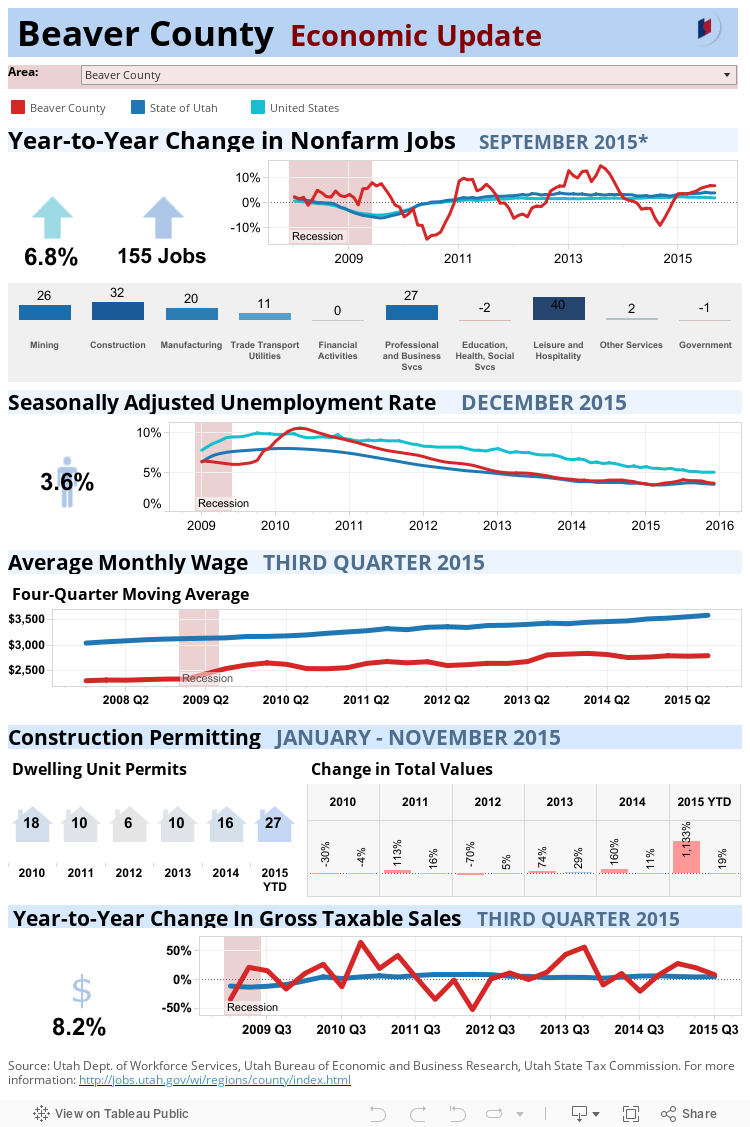
- Between September 2014 and September 2015, Sevier County generated almost 220 new jobs for a growth rate approaching 3 percent.
- Government proved the only major sector with employment declines, and that loss was barely noticeable.
- Leisure/hospitality services contributed the largest number of new positions with resilient advances in health/social services, transportation and retail trade.
- The county’s unemployment rate has shown slight ups and downs during the past year, but the December 2015 figure remains relatively low at 4.3 percent.
- New claims for unemployment insurance followed a seasonal pattern as 2015 came to a close with no significant nonseasonal layoffs.
- Construction, professional/business services and leisure/hospitality services accounted for the largest shares of first-time claims.
- The county’s average monthly wage continued to increase. Year-to-year growth in the third quarter 2015 average wage proved particularly strong at 6.5 percent, although these growth rates can be fairly erratic.
- Construction permitting values appear to be holding their own with a 10-percent increase for the first 11 months of 2015.
- Third quarter 2015 gross taxable sales showed a moderate 3-percent year-over gain in Sevier County.
- In general, retail sales appeared vigorous with building materials/garden stores showing a decided increase.
Millard County Economic Update
After more than two years of expansion, Millard County took a break from job growth in the third quarter of 2015. Although jobs picked up a bit by quarter-end, public-sector losses hampered labor market growth. However, other economic indicators currently show no signs of distress. New claims for unemployment insurance are basically holding in a seasonal pattern and jobless rates remain low. Construction permitting proved robust in 2015 and sales showed a sturdy third-quarter gain. The current slowdown may prove temporary but certainly bears watching.
- Between September 2014 and September 2015, Millard County added 20 new jobs for a tepid growth rate of 0.5 percent.
- Declines in state and local government employment proved the major factor in the employment growth slowdown. Utilities and manufacturing also suffered notable losses.
- On the positive side of the ledger, wholesale trade, private education/health/social services and leisure/hospitality services all generated significant numbers of new positions.
- Despite the public-sector losses, Millard County’s unemployment rate has held relatively steady for the past two years at a low rate.
- In December 2015, joblessness measured 3.5 percent, unchanged from a year earlier.
- In addition, with the exception of a blip in early autumn, first-time claims for unemployment insurance seem to be holding in a seasonal pattern.
- While job growth paused, the county’s average wage actually ticked up a notch.
- Third quarter showed a particularly healthy 3.5-percent year-to-year gain.
- Nonresidential permitting for industrial buildings took the lead in generating a 57-percent increase in total values for the first 11 months of 2015.
- The number of new home permits held steady when compared with 2014.
- With almost a 7-percent increase, Millard County’s gross taxable sales turned in a strong third quarter performance.
- Much of the rise can be traced to a prior-period adjustment. However, retail trade, accommodations and food services all showed notable gains.
Subscribe to:
Posts (Atom)